Christmas Sweater Pattern Ugly Pattern Graphics
As a digital product creator running an Etsy shop and a standalone print-on-demand store, I evaluate hundreds of graphics every year. Most never make it past a quick folder check. The Christmas Sweater Pattern. Ugly Pattern arrived in my review queue right when I was mapping out new seasonal listings for mugs, apparel, and printable gift wrap. What follows is my realistic, hands-on look at this pattern as a commercial design asset — the kind of evaluation I’d do before investing time in mockups, file organization, and listing photography.
What Stood Out in the First Two Minutes
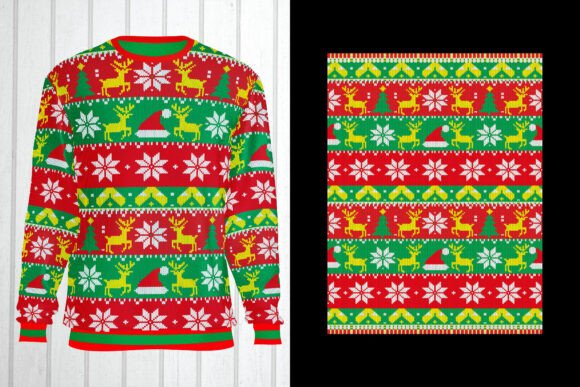
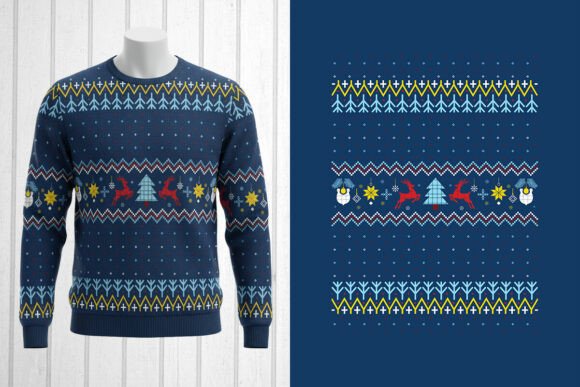
My first scan focused on three things: seamless repeat, motif spacing, and color harmony. The pattern is built around classic holiday imagery — reindeer, poinsettias, mittens with wreaths — in a red, green, and white palette that lands firmly in the playful “ugly Christmas sweater” territory. The repeat is clean and truly seamless. I dragged a tile across a 4000-pixel canvas and didn’t spot any visible seams, which is exactly what I need when using this for fabric prints or full-bleed sublimation on blankets or tote bags. The motifs are distributed evenly, not clumped, and the white space between elements lets the design breathe. This matters when you’re shrinking it to a planner sticker sheet — it holds up better than denser festive patterns I’ve tested.
Visual Personality and the Customer You’ll Attract
This isn’t an elegant, understated winter watercolor. It’s deliberately cheerful, bordering on nostalgic kitsch. For anyone selling in the “ugly sweater” niche — there’s an active search trend on Etsy from October through December — this pattern hits a sweet spot. It’s recognizable without being a copyright-clashing copy of classic knitwear. The poinsettias and mittens give it a handmade, cozy charm, while the reindeer adds a childlike, family-Christmas vibe. I can easily see it pulling in buyers planning tacky Christmas parties, family gathering apparel, or crafters making DIY holiday gifts. From a seller’s viewpoint, this pattern carries the kind of personality that encourages impulse purchases when displayed on a holiday mug or a set of holiday napkins.
For designers building Canva templates, this pattern pairs well with both playful script fonts and big bold sans-serifs. It doesn’t fight for attention if you add a greeting in a thick display font, and it provides a consistent background that keeps social media templates cohesive.
How I Stress-Tested It for Commercial Product Creation
I always run a new graphic through the same practical checks before committing it to a product bundle.
- Print resolution and color accuracy test: I placed the PNG version into a 12×12-inch digital paper template at 300 DPI and did a test print on my home inkjet and a local print shop’s laser printer. Colors stayed true to the festive red-green-white palette. The green didn’t shift muddy, and the red maintained vibrancy without bleeding.
- Seamless repeat verification: I tiled the pattern as a fill in Photoshop, then printed a larger swatch. The repeat held perfectly — no hard lines or awkward join points.
- Mockup immersion: I applied the pattern to a ceramic mug, a crewneck sweatshirt, a tote bag, and a set of holiday gift tags via smart object templates. Across all product types, the pattern scaled well. On the mug, the white space kept the design readable even with the 11-ounce tapered shape.
- SVG cut review (if applicable): The product description implies a seamless design, but if individual motifs come as separate SVG elements, that would expand utility for Cricut users. I worked with the pattern as a full print mainly, so I tested the raster file with a sublimation printer. For cutting projects, the intricate details of the poinsettias would require careful weeding settings — something I note for sticker-sheet sellers.
- Thumbnail simulation: I dropped the pattern into a mockup listing image scaled to 570×456 pixels (a common Etsy thumbnail size). The design still reads clearly as a Christmas sweater vibe. That’s a pass.
Where This Pattern Becomes a Serious Revenue Driver
After testing, I could immediately map Christmas Sweater Pattern. Ugly Pattern onto several product lines I know move volume in November and December.
- Sublimation apparel: Ugly sweater t‑shirts, crewnecks, and even fleece blankets. The pattern’s seamless nature means I can offer full-print leggings or all-over hoodies without worrying about print cutoffs.
- Printable party decor: Gift wrap sheets, treat bag toppers, and place cards. This is a low-effort, high-margin digital download category on Etsy.
- Digital paper packs: I’d bundle this pattern with a coordinating solid cardstock texture and a simpler striped pattern to create a 12-sheet scrapbooking set for Creative Fabrica or my own shop.
- Canva template backgrounds: A landing page or Facebook cover using this as a background pattern would instantly cue a holiday promotion. Add white text boxes and you have a ready-to-edit seasonal template.
- Greeting cards and invitation kits: The white background behind the motifs leaves space for layered text, making it suitable for party invitations or “Merry Christmas” cards.
I’d also experiment with using it as a base for mug designs on print-on-demand platforms like Printful or Printed Mint. The festive character, combined with a clear white zone for personalization, is exactly what sells in that category.
Where You Need to Exercise Caution
Not every product category will treat this pattern kindly. I always note the risk zones before ordering samples or uploading files.
- Very small sticker details: If you plan to create tiny planner stickers under 1 inch, the reindeer and poinsettia details can mush together. Test a scale reduction to 0.75 inches and inspect print outline clarity. For kiss-cut sticker sheets, I’d recommend simplifying or cropping the pattern to larger elements only.
- Dark background merchandise: The pattern rests on what appears to be a white or very light base. Placing it on a dark‑gray hoodie without a white underbase results in color shifting and loss of that crisp contrast. If you go that route, ensure your print partner uses a reliable white underbase for direct-to-garment prints.
- Laser‑cut wood or acrylic projects: The intricate motif edges won’t translate directly to clean cut‑line requirements for a Cricut or Silhouette. Use this for printed products, not as a cut‑file base unless you isolate bold silhouette outlines.
- Overloaded thumbnails: If your product listing already includes multiple decorative accents, using this pattern as a background could reduce visual hierarchy. I’d lean toward using it in mockup photos where the product (an object like a mug or shirt) stands out, rather than as a busy backdrop behind small text.
Using the Pattern to Strengthen Your Listings and Brand Identity
Many digital sellers overlook how a well‑chosen pattern can unify a seasonal collection. I plan to apply Christmas Sweater Pattern. Ugly Pattern as a recurring design element across my holiday product line. That means the same pattern appears on the gift wrap design, the matching thank-you card insert, and the Instagram story template I use to promote the bundle. This consistency raises perceived value and signals to customers that they’re buying from a professional brand, not a random assortment.
When I set up listing photos, I’ll use pattern‑filled frame mockups to create a cohesive look. For Etsy uploads, the thumbnail will feature a close-up of the pattern on a physical product (a ceramic ornament, for instance), because patterns sell best when shoppers can imagine them on a real item. I’ve found that listing images that show the pattern in context — a giftee opening a wrapped present, for example — improve click‑through rates during the holiday rush.
Practical Seller Notes from My Review Process
After verifying the asset, here’s the checklist I’d follow before publishing any finished product.
- File organization for customers: If I resell this as part of a clipart bundle or digital paper set, I’ll create clearly labeled folders and include a preview image. No one wants to sort through unnamed PNGs.
- Commercial license verification: I’ll read the exact terms. Most graphics for commercial use allow up to a certain number of end products for sale. I’ll confirm that print-on-demand usage is covered and that I’m not limited to a specific print-run quantity.
- Color profile check: I convert the pattern to CMYK for print products and offer an RGB version for digital templates. I also test how it looks when printed on matte vs. glossy paper; the red-green contrast shifts slightly.
- Pairing with fonts: For product mockups, I tested the pattern with a bold serif (like Abril Fatface) for a classic look, a clean sans serif (Montserrat) for modern merch, and a loose script (Cedarville Cursive) for a handmade vibe. All three pairings worked because the pattern provides texture without dominating. I’d keep text in a single solid color — white or dark green — to maintain readability.
- SVG optimization: If you receive layered SVG files with separate motifs, give them a quick simplification pass for Cricut users. Reduce anchor points on the poinsettias and reindeer antlers so they cut cleaner. I always test‑cut on scrap cardstock first.
I also recommend creating a short video mockup showing the pattern repeat in motion (like wrapping paper unrolling) for social media promo. Animation catches the eye in crowded feeds and highlights the seamless quality.
Final Verdict for Digital Product Creators
Christmas Sweater Pattern. Ugly Pattern fills a specific, high‑demand niche with enough versatility to star in my Q4 product lineup. It arrives as a ready‑to‑use graphic design asset that doesn’t need heavy editing, and its seamless construction makes it safe for large‑scale printable products. I’d confidently place it in a festive bundle, use it for mockup backgrounds, and list it in sublimation‑focused kits alongside matching ornaments graphics and simple holiday clipart. For Cricut users, I’d lean on it as a print‑then‑cut resource or as a digital paper rather than a complex cut file. As long as you test for small‑scale legibility and check print color behavior, this pattern is a sensible addition to any seasonal commercial collection.