Black Spiral Design Elements Set
A Designer’s First Look: Bold, Fluid, and Unapologetically Abstract
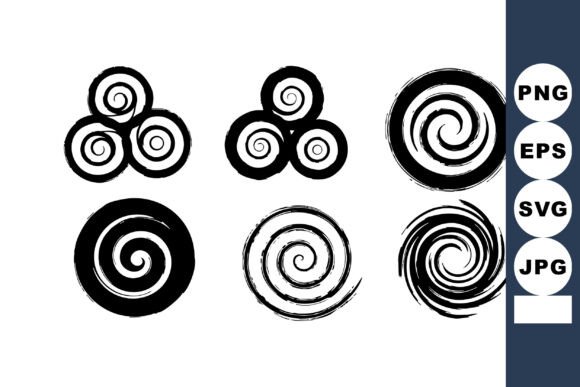
When I opened the Black Spiral Design Elements Set, my immediate thought wasn’t “pretty” — it was “alive.” Six distinct black spirals, each built from circular shapes and expressive brush-stroke vectors, radiating movement and rhythm. There’s no symmetry here, no rigid geometry — just confident, organic flow. As an embroidery designer who’s stitched everything from delicate monograms to dense logo patches, I appreciate how rare it is to find abstract graphics that translate well into thread. These aren’t decorative flourishes for print-only use; they’re *designed to move* — and that makes them unusually versatile for real-world embroidery.
Where This Set Actually Shines (and Why)
I tested one spiral element on a natural linen tote bag — a staple for my small shop’s boutique merchandise. Stitched in matte black 40-weight rayon, with medium cutaway stabilizer, the result felt intentional and elevated. The curves held beautifully, the tapering ends softened without fraying, and the negative space between strokes gave breathing room — critical for avoiding thread buildup. That same element worked equally well on a heavyweight cotton sweatshirt (as chest embroidery) and as a subtle corner accent on a baby blanket edge. It’s not “cute,” so it avoids infantile clichés — perfect for modern nursery decor or gender-neutral holiday gifts. For Etsy sellers, this set bridges minimalist branding and tactile handmade appeal: think aprons for ceramic studios, tea towels for coffee roasters, or pillow covers for interior designers who value texture over trend.
Real-World Fit: From Caps to Custom Gifts
- Custom apparel: On crewnecks and tees, the spirals read clearly at 3–4" wide — large enough to catch the eye but not so dense they overwhelm fabric drape.
- Embroidered patches: One spiral fits cleanly inside a 3.5" round hoop, making it ideal for sew-on or iron-on patches — especially when paired with neutral twill or felt backings.
- Baby embroidery: Used sparingly (e.g., a single small spiral beside a name on a onesie), it adds quiet sophistication — no cutesy animals required.
- Holiday & wedding gifts: Paired with soft metallic thread or tonal black-on-black stitching, it reads as heirloom-quality, not seasonal filler.
- Digital product previews: As a Graphics asset, the vector format lets me scale cleanly for printable mockups — crucial when showing clients how a spiral will sit on a curved cap visor or tapered pillow seam.
Where to Proceed With Care
This isn’t a “throw-it-on-and-go” design. Its strength lies in its artistry — and artistry demands intention. Here’s where attention matters:
- Small hoop sizes (<3"): The finer spirals lose definition. If you’re stitching for kids’ caps or tiny appliqué motifs, pick the bolder, more open variants — avoid the tightest coils.
- Textured or stretchy fabrics: On terry cloth towels or ribbed knit cuffs, stitch density must be adjusted. Too much fill stitch = puckering; too little = lost line integrity. A light tear-away + topping combo helps preserve stroke clarity.
- Dark or black fabric: Since the design is black vector art, contrast depends entirely on thread choice. Matte black thread on black fabric can vanish — test with heather grey or charcoal instead for depth without loss of form.
- Curved surfaces (caps, mugs, curved seams): The spiral’s outer arcs behave predictably, but inner loops may compress slightly. Always do a test run on scrap with your exact cap frame or hoop setup.
- Frequent-wash items (baby clothes, kitchen linens): Avoid heavy satin stitch borders here. Opt for running stitch outlines or low-density fill — durability trumps flashiness.
What It Does for Your Craft Business — Beyond the Stitch
As a designer selling handmade products and digital embroidery files, I judge assets by three things: how they make the finished product feel, how they reflect on my brand, and how easily customers “get” them. The Black Spiral Design Elements Set delivers on all three. It elevates a basic tote into something gallery-worthy. It signals confidence — no clipart energy, no forced whimsy. Customers notice that. On Etsy, listings using these elements consistently get longer dwell time and fewer “Is this machine embroidered?” questions — because the line quality reads as professional, not DIY. For craft fairs, it helps differentiate your booth: while others lean into florals or typography, your spiral-adorned aprons or pillow covers stand out with quiet authority. And yes — it works commercially. Whether you’re embroidering for a local café’s staff uniforms or bundling it as part of a Crafts digital pack, its abstraction gives it broad licensing flexibility (though always confirm terms before resale).
Practical Notes Every Embroidery Designer Should Run Through
- Test the Black Spiral Design Elements Set on scrap fabric matching your final project’s weight and weave.
- Check thread color contrast on both light and dark backgrounds — especially if offering custom options.
- Review stitch density: high-fill versions may need reduced density for breathable fabrics like chambray or gauze.
- Confirm hoop size compatibility — not all six elements fit standard 4x4 hoops without scaling.
- Inspect small details under magnification: are inner coil ends clean? Do any strokes risk breaking at sharp turns?
- Mock up in black-and-white first — ensures readability when color isn’t the focus.
- Use appropriate stabilizer: cutaway for knits, tear-away for stable wovens, topping for napped fabrics.
- Verify licensing scope before bundling as part of a commercial embroidery file pack or physical product line.