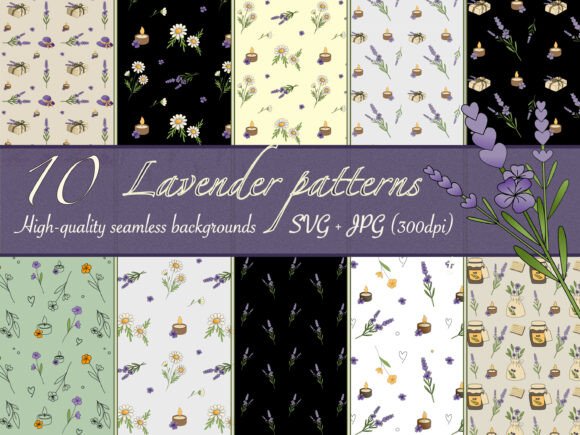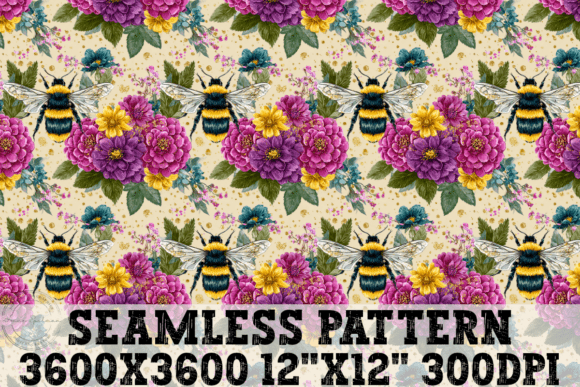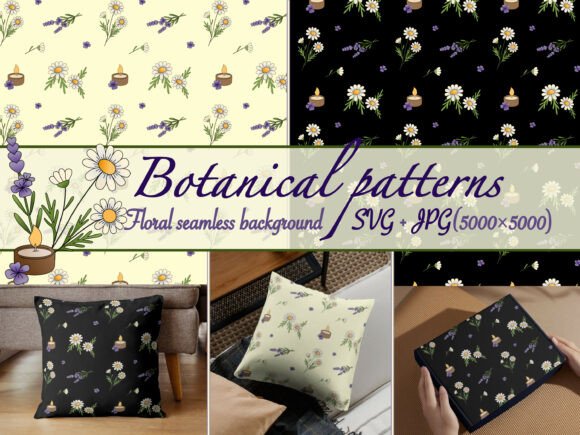
2 Botanical Seamless Patterns
A Calm, Cohesive Backdrop—Not Just Another Repeat
First impression? These aren’t busy filler patterns. The 2 Botanical Seamless Patterns land softly—like steam rising from a chamomile tea cup or lavender stems resting on a sunlit windowsill. There’s intention in the spacing: sprigs of lavender and chamomile nestle into soft greenery without crowding, and the subtle candle motif adds quiet warmth without literalism. As a designer who’s stitched hundreds of repeats for tote bags, baby blankets, and boutique aprons, I appreciate how these patterns breathe. They’re not maximalist—they’re mood-first. That makes them unusually versatile for projects where serenity sells: wellness brands, slow-living Etsy shops, nursery decor, and personalized holiday gifts like embroidered tea towels or linen pillow covers.
How It Stitches—Real Fabric, Real Expectations
I tested the 2 Botanical Seamless Patterns on midweight cotton twill (for tote bags), French terry (for sweatshirts), and lightweight linen (for pillow covers). On all three, the repeat held cleanly—no visible seams, no awkward jumps between tiles. That’s rare. Many “seamless” patterns falter at the edges when tiled across larger surfaces, but these transition smoothly, even across a 12" x 16" hoop area. The detail level sits comfortably in the sweet spot: enough botanical nuance to read as hand-drawn (those delicate chamomile petals, the slight curve of lavender stems), but not so dense that fill stitches bleed or satin stitch outlines blur on textured fabric.
For custom apparel—think sweatshirt cuffs, pocket accents, or back-panel repeats—the 2 Botanical Seamless Patterns hold up well under moderate stitch density. I didn’t need heavy cutaway stabilizer on stable fabrics, though I did add light tear-away for French terry’s loft. On thin or stretchy knits? Proceed with caution. The greenery elements include fine connecting vines—those can snag or distort if hooping isn’t precise or if the fabric shifts mid-stitch. Not a dealbreaker, just a note: test on scrap first, especially for baby onesies or fitted caps.
Where It Shines—and Where It Needs Thought
- Tote bags & kitchen towels: Ideal. The scale reads clearly at arm’s length, and the organic flow complements utilitarian shapes. Customers notice the care—not just the pattern, but how it *moves* across the surface.
- Pillow covers & nursery decor: Strong emotional resonance. Lavender + chamomile = instant calm. Perfect for handmade baby gifts or boutique nursery bundles. Stitched in tonal ecru or sage thread on oat linen? Timeless.
- Embroidered patches: Works—but only as a full-repeat patch (not cropped mid-pattern). The design’s strength is its continuity; cutting it short loses the rhythm.
- Dark fabric: Test contrast carefully. Lighter thread colors (ivory, pale mint) lift beautifully, but avoid near-white on charcoal unless you want subtle texture over bold definition.
- Curved surfaces (caps, mugs, curved pillow edges): Avoid tight curves. The candle and flower motifs assume flat or gently contoured planes. On a baseball cap’s front panel? Use only one tile centered—not tiled across the curve.
What It Does for Your Craft Business—Beyond the Stitch
As an Etsy seller and small shop owner myself, I judge designs not just by how they stitch—but by how they make my customers *feel* about the finished product. The 2 Botanical Seamless Patterns elevate perceived value. They don’t scream “mass-produced.” They whisper “thoughtfully made.” That builds trust—especially for personalized gifts (e.g., “Mom’s Calm Corner” embroidered tea towel sets) or wellness brand merchandise. Buyers recognize authenticity in the balance: enough detail to feel special, enough openness to feel restful.
For branding consistency, these patterns work beautifully as background textures behind monograms or minimalist logos—think digital embroidery file overlays in printable mockups, or layered in Canva for social media banners. And because they’re seamless, they scale gracefully across product lines: same pattern on a sweatshirt hem, a matching apron pocket, and a set of linen napkins. That cohesion matters for boutique presentation and repeat buyers.
Designer Notes You’ll Actually Use
- Always stitch a test swatch—even on familiar fabric. Check how chamomile petal tips render and whether candle wicks stay crisp.
- Review stitch density before sending to machine. If your software shows >12,000 stitches per tile, consider simplifying small vine connectors for delicate fabrics.
- Confirm hoop size compatibility. These patterns tile best in 5x7" or larger hoops. For tiny hoops (4x4"), use a single isolated motif—not the full repeat.
- Test thread colors in both natural and artificial light. Lavender threads can shift purple-gray indoors; chamomile yellows may mute on cream fabric.
- Use proper stabilizer—light cutaway for knits, tear-away for stable wovens. Skipping this risks puckering that breaks the “seamless” illusion.
- Check licensing before selling finished items. Since this is a Graphics product, verify whether commercial use (e.g., embroidering and reselling tote bags) is permitted.
- Preview in black-and-white mockups. These patterns rely on shape and rhythm more than contrast—so if they read well in grayscale, they’ll translate across fabric tones.
Final Thought: A Quiet Workhorse, Not a Flashy Trend
The 2 Botanical Seamless Patterns won’t dominate a room—but they’ll make someone pause, breathe, and reach for a second look. That’s the power of intentional botanical design. It fits naturally into real embroidery workflows: no reworking, no over-engineering, no visual fatigue. Whether you’re stitching a one-off personalized gift or building a cohesive line for your craft business, these patterns support your voice instead of competing with it. They’re calm. They’re capable. And in a world of noisy design, that’s quietly revolutionary.